LifeWind: a game where you do not choose where you are born
LifeWind is a free browser game: a random country, family and income drawn from UN and World Bank statistics, then one life lived year by year. How I built it in a week, what is inside and where to play.
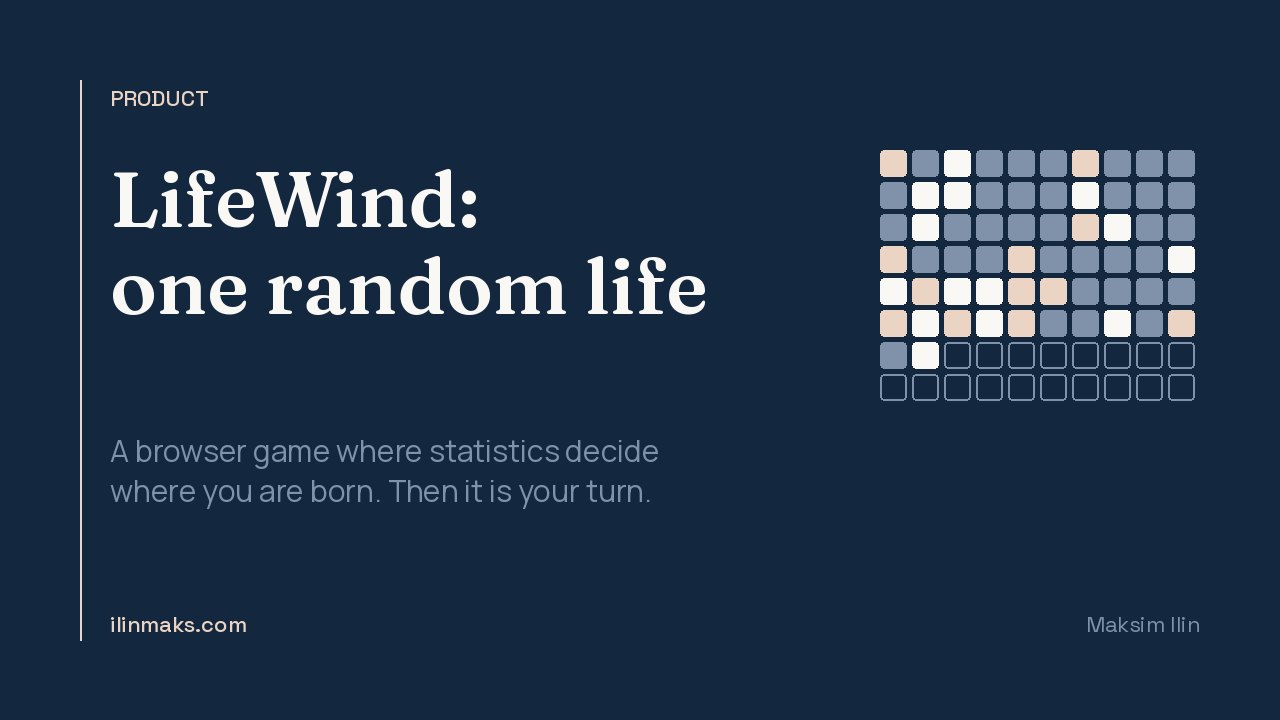
The first life my own game handed me began in a village near Kunduz, Afghanistan. Mother 18, father 23, a street vendor. Life expectancy 61, family income 74 dollars a month per person, a 5.6 percent chance of dying before the age of five. I pressed one button and that is what I got. This is how LifeWind works: you do not choose the country, the family or the money, statistics choose them for you, and then you live that life year by year.
The game is free, it opens in a browser on a phone or a computer, no download and no account. The interface is in English for now. You can play on lifewind.app and on Game Foundry.
What happens when you press the button
The start screen has one line: about four children are born on Earth every second, press the button and become one of them. Below it two counters: how many children have been born since you opened the page, and how many people have died. By the time you finish reading the description the numbers are past a hundred.
After the press comes a birth record. Name, sex, city or village, the family's means by the standards of its country and by the standards of the world (these are different things: a middle income in Morocco and poverty in the United Kingdom can land next to each other on the world scale), the parents' ages and jobs, how many rooms the home has, how many older siblings. At the bottom is the line I like most: who was born in the same second. Next to my Afghan boy, Vivaan was born in a village in India, Carlos in Luanda and Aoi in Osaka.
Then the years run, at anything from one to sixteen years a minute, or with a button that jumps to the next decision. Decisions come on their own: at five you choose what to do with yourself, learn alone or play with friends in the yard, and each option says plainly what will grow and what will drop. At school, at university, at work the forks multiply: a field of study, a job, a business, housing, purchases, loans, family, health. You can quit a job, turn down a vacancy, sell a business and stop working altogether if the money allows.
Sometimes the game asks a question with no right answer. At five it asked me: how will you remember the first summer of your life? One line, and you can leave it blank. Those lines later sit in the life map, where every year is a square and the colour of the square is your happiness at the end of that year.
Where the numbers come from
Everything in the game that depends on the country is computed from open data: 81 countries, UN population statistics for 2024, the World Bank, the WHO, UNESCO, the Human Development Index, the World Happiness Report. The chance of being born in a country is proportional to its share of world births, so India and Nigeria come up often and Croatia rarely. Mortality follows the Gompertz and Makeham model, incomes a lognormal distribution, which is how demographers and economists usually describe them, rather than a guess.
Still, the game is not a forecast. It is one of many possible stories, assembled from rules and chance. I wrote that on the start screen on purpose and I will repeat it here: do not make medical or financial decisions based on it.
Money is shown in the currency you pick: dollars, euros, roubles, pounds, yuan, rupees and a few more. That is display only, you cannot get a richer family by choosing a currency.
What is in the game because I wanted it there
A few things went in not because games usually have them but because I wanted them.
If you open the game late at night it will not let you be born straight away. A window appears: it is late, this life can wait until morning, your real one needs sleep. You can press be born anyway, and that is a choice too.
At the bottom of the start screen there is a link for anyone who is struggling right now. The game has illness, loss and death in it, sometimes sudden, and I did not want a person in a bad place to be left alone with that.
Saves live in the browser, and the My lives section keeps every life you have played. At the end of a life there is an optional form: write what was missing or what felt wrong. No name, no email. I read those, and some of the fixes in the game already come from there.
How it is built
The first commit in the repository is dated 29 October, the game appeared on Game Foundry on 3 November, with a little over a hundred and thirty commits in between. The engine is written apart from the interface and runs without it: a seeded random generator, mortality, incomes, events as data that can be added in sets without touching the rest. The interface is React and TypeScript, state in Zustand, saves in localStorage and IndexedDB, a small Node server for feedback and the counters. Hosting on Railway, domain lifewind.app, and the game installs on a phone as a PWA.
The code was written with AI coding assistants under my direction. My work in this project is the decisions: which events are needed, what counts as honest balance, where the game should stop a person and where it should let them go.
Balance is a story of its own. Every option in a decision has to have its own upside and its own price, and the arrows in the hints have to match what will really happen. For that the project has an audit: it plays out every option in the same situation and compares the consequences ten years later and at the end of life. If some option turns out better in every way, or a hint lies, that is a bug and it gets fixed. The one exception I kept on purpose is illness: treating it in time is honestly better than putting up with it.
What comes next
I handed the game to Game Foundry, a platform for browser games, and I am watching people I do not know play it. What comes next depends on feedback: more events in adult life, a translated interface and, possibly, a classroom mode where a class lives several lives and talks about why they turned out so different.
If you want to try, press Be born on lifewind.app and see where the statistics put you. In one of my runs it was Shenzhen, China, a girl named Lan.
FAQ about LifeWind
What is LifeWind?
A free browser game that simulates one human life. Statistics choose the country, the family and the means, then you make the decisions year by year: study, work, money, housing, family, health.
Is it free, and do I need an account?
Yes, it is free and no account is needed. Saves are stored in your browser, so to continue a life open the game in the same browser on the same site.
Can I choose my country of birth?
No. The chance of being born in a country is proportional to its share of world births according to UN data for 2024. You can choose the currency for displaying money, and that does not affect the starting family.
How much of the game is based on real data?
Starting conditions and mortality are computed from open statistics for 81 countries: the UN, the World Bank, the WHO, UNESCO, the UNDP. The life story itself is rules and chance, a simulation rather than a forecast for a real person.
Which languages and devices does it support?
The interface is in English for now. It works in a browser on a phone or a computer and installs on a phone as an app. You can play on lifewind.app and on Game Foundry.
Keep reading
All articlesHow to think about AI: two hours with Dmitry Merkulov
A philosopher and a practitioner spent almost two hours talking not about how to use AI but about how to think about it. Key ideas, chapters with timestamps and the article series.
ReadAI native: what it means and why the word artificial gets in the way
AI native means AI is built into the work rather than living as a separate project. We look at the word itself, at what artificial means in English and in Russian, why vibe coding replaces neither the programmer nor the employee, and where an AI-native company starts.
ReadAI adoption in a company: where to start when nobody knows where to start
AI adoption means bringing AI into the daily work of a company. Step by step: who should build the first agent, which process to pick, what stays manual (registrations, tokens, access), what it costs and which mistakes we see most often.
Read