How I build websites with Lovable and get them ready to launch
What Lovable is, when it works well for websites and MVPs, and why a strong first draft still needs product thinking, SEO, testing and launch work.
Lovable can produce a polished first screen very quickly. Turning that screen into a website that explains the business, works well on a phone, captures enquiries and gets indexed takes more work. That second part is where I spend most of my time.
I use Lovable for websites, interfaces and first product versions. My workspace includes my personal portfolio, the ITDepart B2B website, the RoboHub robot catalogue, commerce prototypes for Cranberries and KISIN, the interactive Catch Me project, and product interfaces for PANX and LoopFlip. Each began with a different business problem, so I did not treat them as variations of the same template.
I will leave the technical recipe out of this article. The useful question is where Lovable saves time, what still needs careful decisions and when I choose another platform.
What Lovable is
Lovable is a platform for creating websites and web applications through a conversation. You describe the goal in plain language, set a visual direction, attach materials and get a working interface that you can keep changing.
The result can go beyond a mock-up. You can publish a project on a lovable.app address or connect a custom domain. You can sync the code with GitHub and add data, authentication and server logic through Supabase. Lovable documents each option in its guides to publishing a project, GitHub integration and Supabase integration.
For a client, the useful part is simpler. You can review a live page instead of discussing a presentation. It becomes much easier to judge the structure, read the copy and test the next action.
What I build with Lovable
Most requests fall into one of these formats:
- a company or personal website;
- a landing page for a service, campaign or launch;
- a clickable product prototype;
- a first web app with login, data or a simple account area.
My portfolio needed a distinct voice while keeping very different projects inside one clear structure. ITDepart needed a direct B2B route from services to a qualified enquiry. Cranberries and KISIN were about testing commerce flows. PANX and LoopFlip were product experiments where behaviour mattered as much as appearance.
Lovable speeds up the first visual pass. The quality still comes from decisions about structure, copy, priorities and page behaviour.
Five examples from my Lovable workspace
Using one platform does not mean producing one visual style. These five projects have different goals, audiences and personalities. They are live pages, not presentation mock-ups.
MoonMask Creator Hub
A page for creators who accept support in cryptocurrency. The calm, premium interface supports a short journey: create a page, add wallet options and share one link. Open MoonMask.

KISIN Shop
A compact storefront for an independent fashion label. The work focused on atmosphere, a strong opening screen, a direct route to the products and Telegram contact. Open KISIN Shop.

Valeria Kulakova's portfolio
A personal website for an SMM manager and content creator. Instead of a standard online CV, the page uses an editorial layout, a clear introduction and a language switch. Open the portfolio.

Vince Media AI Studio
A service landing page for AI avatar production. The opening screen makes the audience, result and main action clear without a long explanation of the technology. Open Vince Media AI Studio.

KIMAX
A fashion storefront concept with an editorial feel. One large image establishes the brand mood while the minimal navigation keeps the collection at the centre. Open KIMAX.

RoboHub: a catalogue built as a search bet
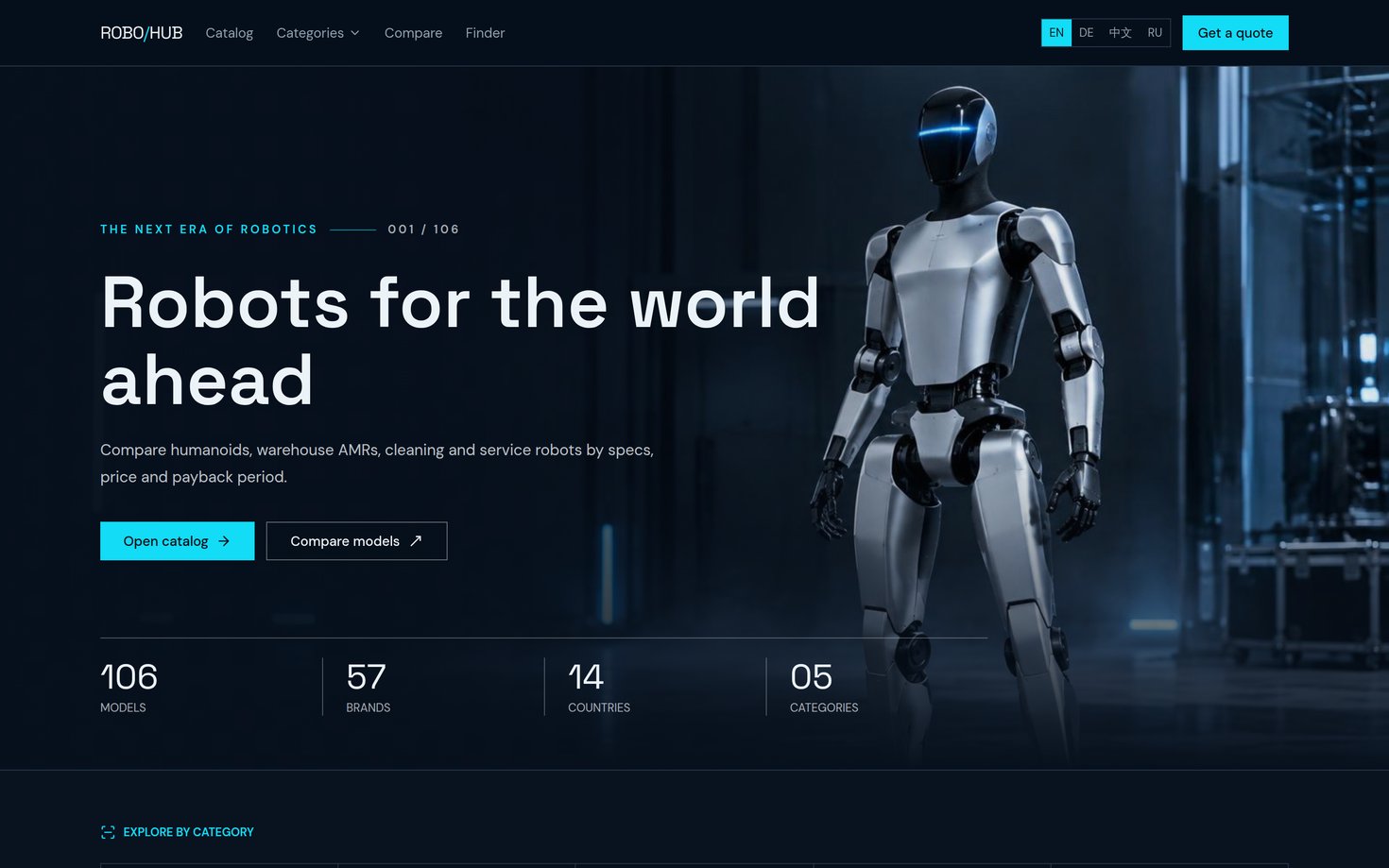
The five pages above each do one job. RoboHub is a different kind of build: a catalogue with its own taxonomy, its own comparison logic and four language versions, started in Lovable and finished in the repository. It is the project I point to when someone asks whether the platform stops at landing pages.
It collects humanoids, robot dogs, warehouse, cleaning and service robots: 106 models in five categories, each with a spec table, an availability status and a price where a public one exists. You can filter by industry, task, locomotion, environment, supply status and country, put models side by side, or answer five questions and get three suggestions. The interface runs in English, German, Chinese and Russian, and every language has its own address.
I will say plainly what it is not. There are no supplier contracts behind it, no stock and no enquiries yet, and the quote forms still do not send anywhere. It is a prototype, and the bet is about timing: in a few years comparing robots will be an ordinary purchasing question, and the pages that answer it need to be indexed long before the first buyer types the query.
The first Lovable version looked finished and was not. The language switcher changed the text but not the address, so Google could read one language out of four. I wrote that up separately, with what it took to fix: my Lovable site looked finished, Google could read one language out of four.
Why the first prototype is rarely enough
A first version can look convincing on one screen and fall apart under ordinary use. A heading wraps badly on mobile. A button leads nowhere. A form gives no response after submission. Old project details remain in the metadata. A large image slows down the entire page. The layout looks good, but a search engine has little useful information to read.
Before launch, I review the project as a visitor and as the person responsible for the business. I check whether:
- the offer makes sense within the first few seconds;
- the website is comfortable to use on a phone;
- forms, links and core flows work;
- every page has useful titles, descriptions and social previews;
- the domain, analytics,
robots.txtand sitemap are set up; - the project can be updated safely after launch.
Lovable has an SEO and AI search review that checks metadata, sitemaps, robots.txt, canonical URLs, mobile usability and accessibility. It is a useful checklist, but it cannot replace clear content, real examples and sensible navigation. The current features are explained in Lovable's SEO and AI search documentation.
When I choose Lovable
Lovable works well when a business needs to launch and test a website, landing page, account area, catalogue or early product version quickly. It is strongest when the goal is clear, the content can be prepared without months of approvals and the main user journey fits into a small number of screens.
I choose the platform after looking at the job. A store with a large catalogue, checkout, shipping and order management often belongs on Shopify. A product with complex roles, unusual logic or specific infrastructure requirements may need custom development. Sometimes Lovable is the right place for the prototype while the working version uses a different stack.
The choice starts with the job:
- 01Lovable when a fast first launch and flexible interface work matter most.
- 02Shopify when the business depends on products, checkout and order operations.
- 03Custom development when the product depends on its own logic, integrations and access rules.
These options can work together. A store may run on Shopify while a campaign landing page or internal dashboard lives as a separate web project.
How I run a website project
I begin with the one action the visitor should take. Send an enquiry, choose a service, book a call, buy a product, or understand the offer and request a demo. The structure and copy come next. The interface follows them.
A compact website or MVP can have a working first version within a week. A tested product with integrations and a proper launch usually starts at two weeks. The exact schedule depends on the number of pages, the state of the materials and any outside services involved.
A client needs a website on their domain that answers customer questions and leads to the next step. Mobile layout, basic SEO, forms, analytics, link checks and publishing are part of that result.
Can you build a Lovable website yourself?
Yes. Lovable is a practical way to test an idea, create a personal page or make a first draft. The difficult part often arrives later, when ten pages need one consistent system, enquiries need to be stored, technical errors need fixing and the site needs to be prepared for search engines.
If you want to try it yourself, begin with one page and one action. Do not ask the first version to contain a customer account, blog, store and three languages. First check whether someone seeing the project for the first time understands the main path.
If the website is for a business, I can handle the structure, copy, interface, integrations, testing and launch. I do not work only with Lovable. I use Shopify or custom development when either is a better fit.
Frequently asked questions about Lovable website development
Is Lovable suitable for a real business website?
Yes. A Lovable project can be published, connected to a custom domain, given its own metadata and updated after launch. A business website still needs a clear structure, useful copy, working forms and a deliberate customer journey.
Can Lovable use a database and user authentication?
Yes. Lovable supports its own cloud backend and a Supabase integration. Supabase can provide PostgreSQL data, user accounts, file storage, real-time updates and server functions.
Can I export the code from Lovable?
Yes. You can connect a project to GitHub and continue working with the code outside Lovable. This is useful for backups, collaboration and deployment on other infrastructure.
How long does a Lovable website take?
A compact MVP or landing page can be shown within a week. A working product with several pages, integrations, mobile work and testing usually takes at least two weeks. I confirm the schedule after the pages and the main user journey are clear.
Do you build only with Lovable?
No. Lovable is useful for fast launches and product prototypes. I use Shopify for commerce projects and custom development for services with specialised logic. I choose the platform after reviewing the job.
How do I hire a Lovable developer?
Send a short description of your business, the audience and the action visitors should take. I will suggest a first version, schedule and suitable platform. You can start a conversation here and see selected work in my portfolio.
Related services
Keep reading
All articlesMy Lovable site looked finished. Google could read one language out of four
What the first Lovable version of a robot catalog got right, what Google could not read, and the three checks to run before you launch a site that lives on search.
ReadI put my own face on the front page. How I launched Likeness House
How I built Likeness House: a bilingual Node.js website with enquiry forms, client accounts and an admin panel. A case study from my own product.
ReadWhat You Can Actually Ship in Two Weeks with AI Tools
A realistic two-week scope with AI tools: a landing page with a lead bot, an MVP with auth and one core flow, or an AI agent for one process.
Read