A tiny world with no rewards. What minimir is testing, and why a first null result still counts
minimir is an artificial life experiment: simple creatures, tiny neural networks, no rewards. It asks whether wanting appears when a creature can sense itself. The first measurement shows a signal lost in noise. What that means and what comes next.
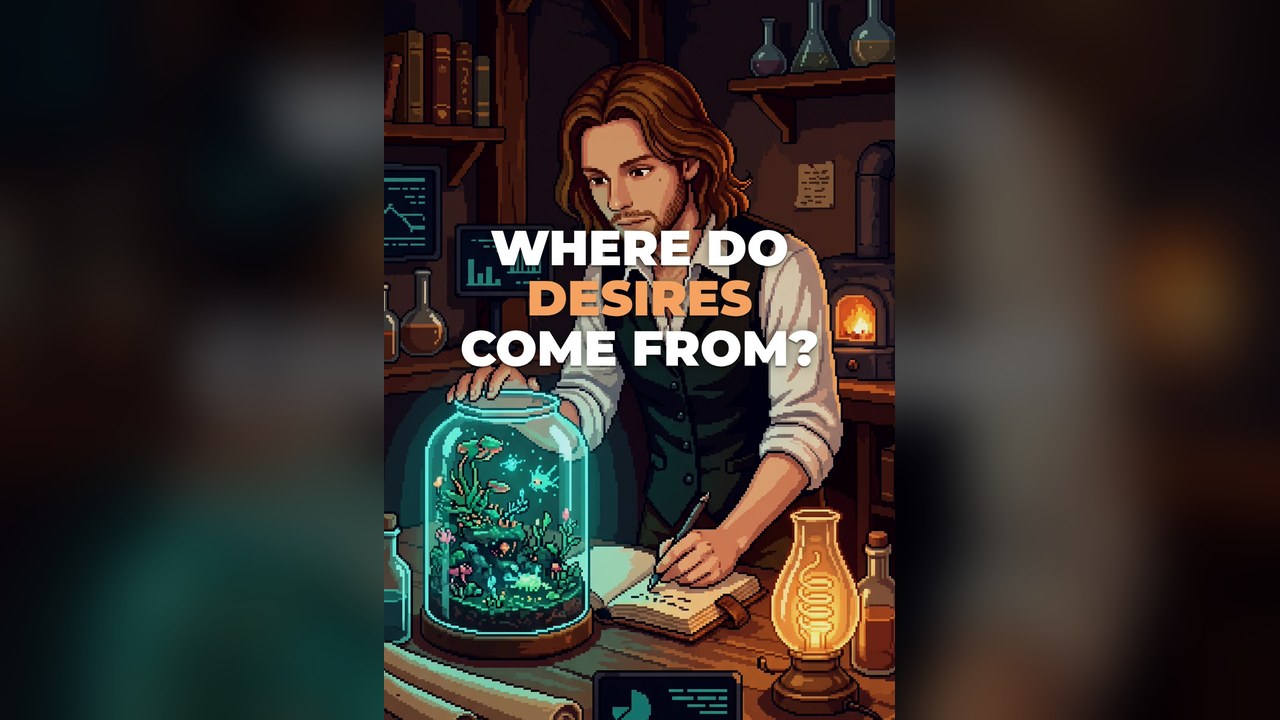
I built a small world on a computer to look at one question: where does wanting come from? This is minimir, my artificial life experiment, and this is where it stands after the first measurement.
What lives in the world
The creatures in minimir are very simple. They look for food, burn energy as they move, reproduce and die. Each one is driven by a tiny neural network, and that network passes to the offspring with mutations. Over many generations the population changes on its own, through nothing more than who survives long enough to reproduce.
There is one thing I deliberately left out. I do not give the creatures rewards or goals. Nobody tells them that food is good or that dying is bad. If anything that looks like a drive shows up, it has to come from the setup itself, from selection and from what a creature can sense.
The question
The question is narrow on purpose: does something like a desire appear if a creature can feel itself?
To test that, I run two worlds that start from the same ancestor. In the first world, a creature knows how much energy it has. In the second world, a creature receives the same kind of numbers, in the same place in its inputs, but the numbers belong to a different creature. It is like watching a neighbour's fuel gauge instead of your own. Everything else about the two worlds is identical.
If sensing yourself matters, the two populations should drift apart in how they behave. If it does not, they should look the same.
What the first measurement showed
The first tests have not shown a difference. There is a signal, and it gets lost in the noise. That is the whole result so far, and I am writing it down exactly like that in the observation journal, rather than rounding it up to a finding.
Why a null first result is still a result
A first measurement that shows nothing clear tells me three things. The instrument works end to end, from the two worlds to the comparison. The effect, if it exists, is small enough that the current setup cannot separate it from noise. And the next step is to change what gets measured and how much of it, rather than to tell a better story about the same data.
That is a normal place for an experiment to be after one pass. The temptation in a public project is to publish only when something clicks. I would rather publish the first pass as it is, because the journal is more useful when it shows the misses as well as the hits.
What comes next
The next experiments build on the work of Gregory Bateson, Evald Ilyenkov and Lev Vygotsky. Each of them, in a different way, looked at how a mind grows out of relations with an environment and with others rather than appearing fully formed inside a single head. I am designing the next round of worlds around those ideas.
How the video was made
The 42 second video is pixel art. The clips were animated in Dantiva, my own video service, and the English voice is a clone of my own.
Where to look
The observation journal is open at minimir.ilinmaks.com. The case study is in the portfolio on this site, and the code is on GitHub.
FAQ about minimir
What is minimir?
minimir, also called mini-world, is my artificial life experiment: a small simulated world where simple creatures search for food, spend energy, reproduce and die. Each creature is controlled by a tiny neural network that is inherited with mutations.
Do the creatures get rewards or goals?
No. There is no reward function and no goal set by me. Whatever drives appear have to come from selection and from what a creature can sense.
What exactly is being tested?
Whether something like wanting appears when a creature can sense its own state. Two worlds start from one ancestor: in one, creatures know their own energy; in the other, they receive the same kind of numbers, but from another creature.
What did the first measurement show?
No clear difference yet. There is a signal, and it is lost in noise. It is the first measurement, and the study continues.
Where can I follow the experiment?
The observation journal is at minimir.ilinmaks.com, the case study is on ilinmaks.com, and the code is on GitHub at akela1308/minimir.
Keep reading
All articlesA city where nothing hurries you. Zagreb Pomalo
A browser game about the real centre of Zagreb. A day lasts 48 minutes, a hostel bunk is 18 euros a night, a room of your own is 450, and that arithmetic is the plot.
ReadMy Lovable site looked finished. Google could read one language out of four
What the first Lovable version of a robot catalog got right, what Google could not read, and the three checks to run before you launch a site that lives on search.
ReadDantiva got its first paying customer. Then the product changed again
A founder update on Dantiva: the first confirmed purchase, the first monthly subscription, a rebuilt light workspace, a Gemini LLM studio, GPT Image 2.5, and two Croatian innovation applications.
Read