A city where nothing hurries you. Zagreb Pomalo
A browser game about the real centre of Zagreb. A day lasts 48 minutes, a hostel bunk is 18 euros a night, a room of your own is 450, and that arithmetic is the plot.
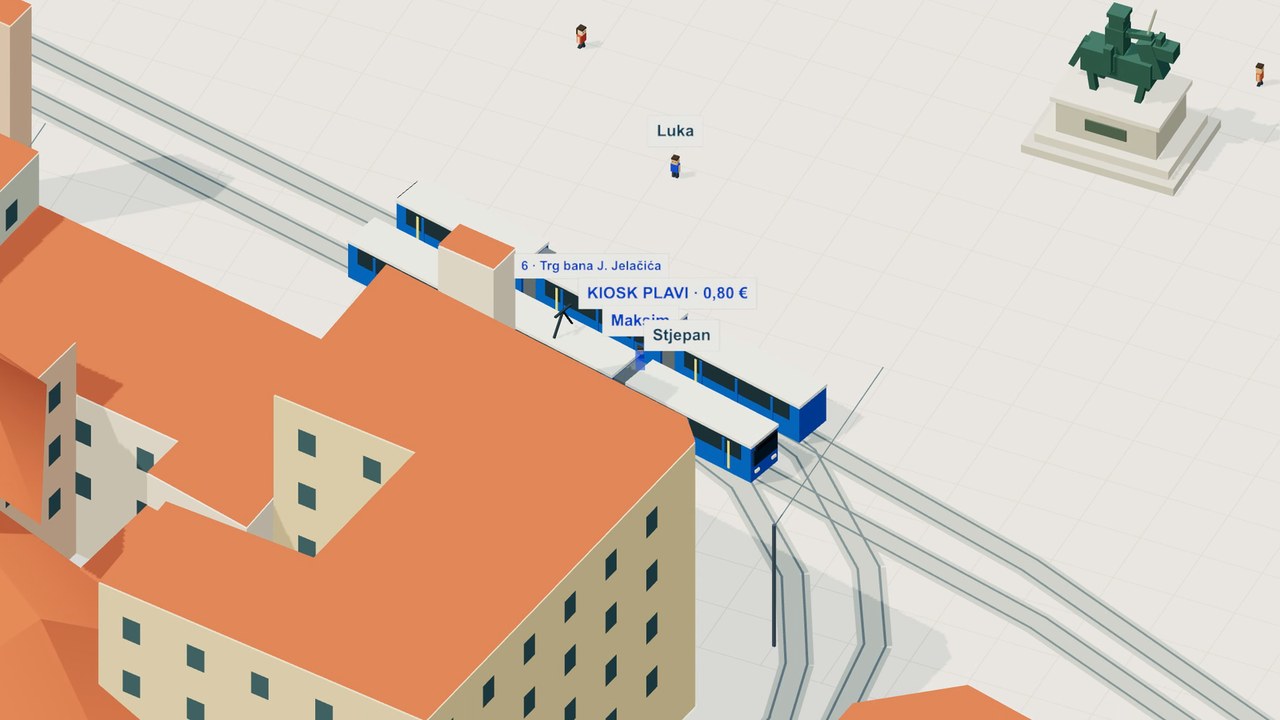
Zagreb Pomalo is a browser game about the centre of Zagreb. You open a link, type a name, and half a minute later you are standing on Ban Jelačić Square. Nothing to install, no account, and no way to lose.
I have lived in Zagreb for two years, and in all that time the word I hear most from locals is pomalo. It means roughly slowly, easy, there is time. It is not laziness, it is a way of handling time. I wanted a game built around that word, and then spent half a year finding out that a calm game is much harder to make than a game about hurrying.
What it is
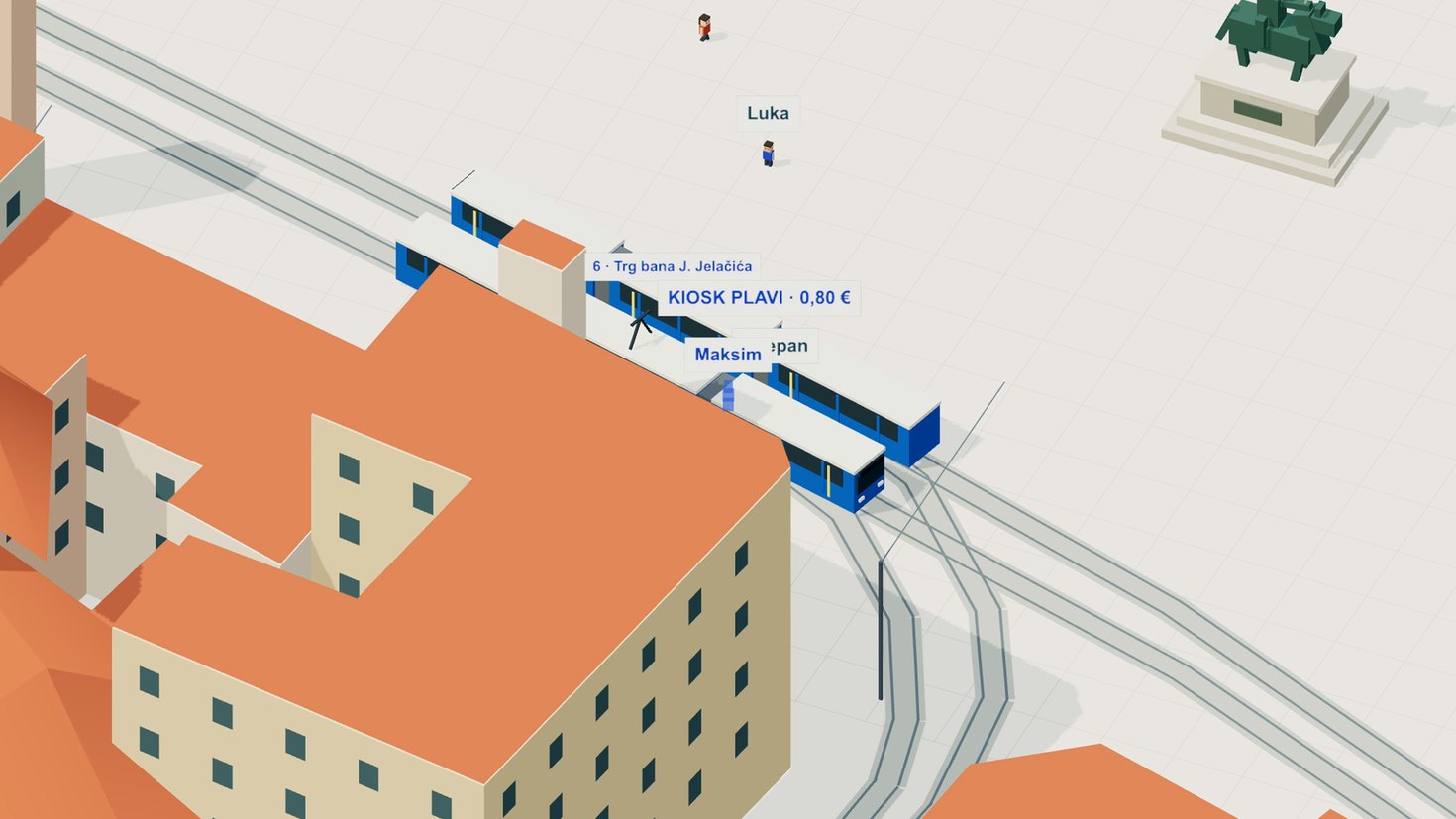
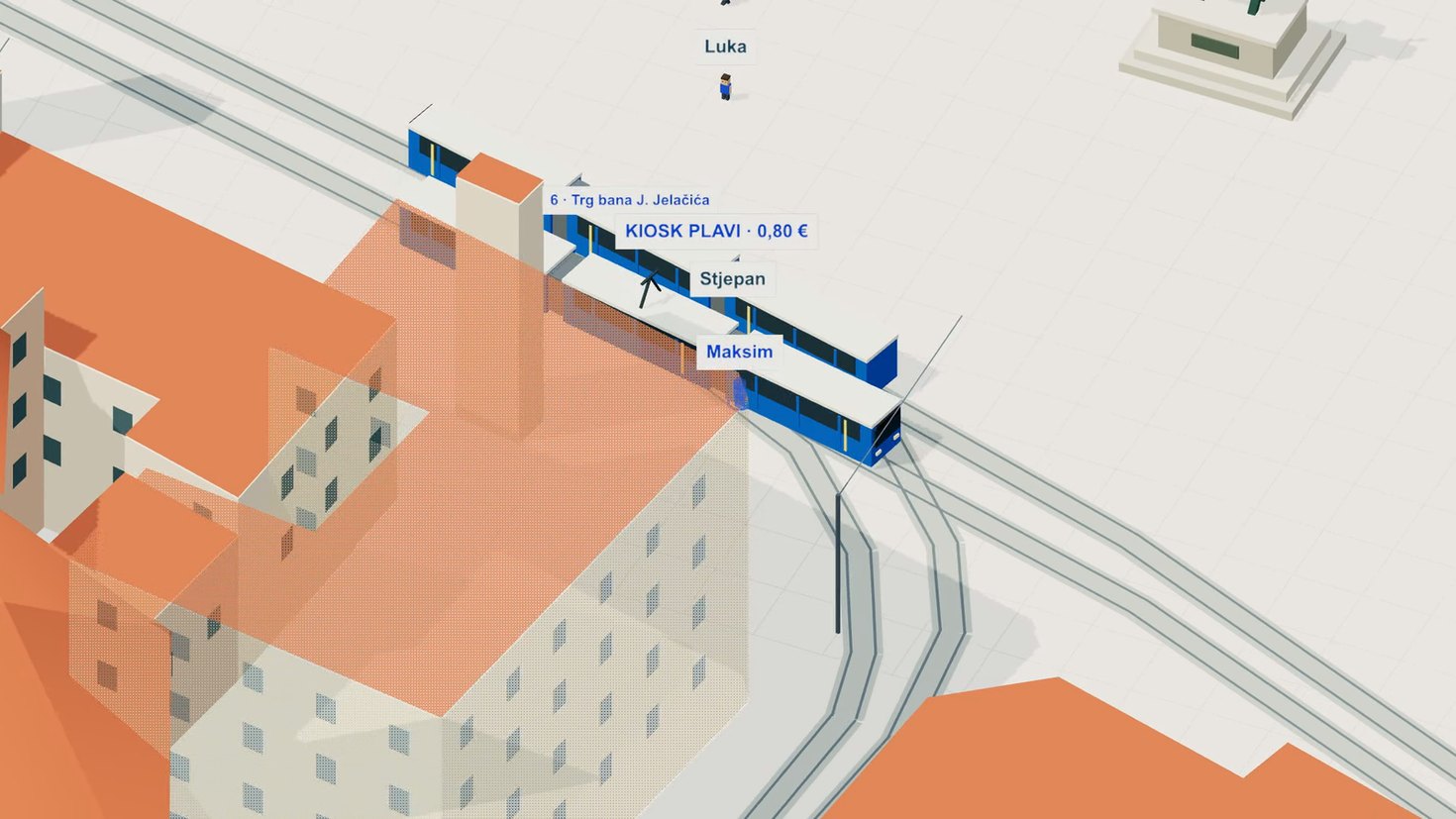
The city is real. Ilica, Tkalčićeva, Zrinjevac, Dolac, Petrinjska, Vlaška, with the real addresses on the doors and the real shape of the blocks. A blue tram runs on the rails, cars drive the streets and stop at the lights, people and cats walk the pavements. The doors open: a café, a bakery, a workshop, a bookshop, a photo studio, a hostel, a gallery, a courtyard. Each room has its own plan, its own furniture, its own person behind the counter.
There is little to do, and it is enough. Sit down on a stool. Order a coffee. Talk to a neighbour. Take up a story and see it through. The stories are short, there are fourteen of them, and they are about ordinary things: deliver a postcard, help with a move, find the owner of something lost, put together a courtyard party.
You can also bring friends. Type a room name, send it to them, and you are walking the same Zagreb at the same time, seeing each other.
Why a calm game is hard
The first version was beautiful and empty. The city stood, the tram ran, the cats walked, and precisely nothing happened. It turns out you cannot have calm without some tension: if nothing constrains the player, it does not matter where they go, and when it does not matter, they are bored in eight minutes.
The tension had to be the kind that never becomes stress. There is no death in this game and there will not be. No hunger that kills you. You cannot lose your things, you cannot go into debt, you cannot lose.
I settled on the day. A game day lasts 48 minutes. The day has a length, and that length depends on how you spent the night.
The night
At eight in the evening the lamps come on and you have to decide where to sleep.
A bunk in a hostel is 18 euros a night. A room with a door that closes is 30. A hotel room is 55. A park bench is free, and the bench has its own arithmetic: most nights pass quietly, sometimes a police officer politely asks you to move on and you wake early by the nearest door, and once in a while somebody puts a jacket over you while you sleep and the morning is warmer than you expected. In none of these cases do you lose anything. Only one thing changes: how much day you get tomorrow.
That is the whole punishment in the game. Not a fine, not a deduction, just a shorter day. The idea is borrowed from Stardew Valley, where a bad day lands on tomorrow morning instead of taking something from you right now.
Energy works with the same restraint. Walking is nearly free, running costs noticeably more, a stool and a coffee give a little back, lunch at the canteen on Petrinjska for 3 euros gives back a lot, and only sleeping in a bed returns a full day. At zero you do not collapse. You just walk, and cannot run.
Work and money
Once there are prices, there has to be money, and it has to come from somewhere.
You can ask for a job in a café, but only after the owner knows who you are. Then you stand at the counter, take orders, carry them to the tables, earn 1.20 per order and a tip when a guest is happy. A full day shift pays 44 euros. You can also rent an empty premises on Tkalčićeva for 12 euros a day, put up a sign of your own, and sell what you made yourself.
Or you save. A room of your own in the city costs 450 euros, once, and after that a night costs nothing ever again. That is about three weeks of shifts. This arithmetic, 18 euros a night against 450 once, is the actual plot of the game. Nobody explains it to you. It is simply there, and at some point you catch yourself doing the maths.
What I would do differently
I would start with the night. I built a city for half a year and only then worked out why anyone should be in it, when the right order is the opposite: first understand what a player's day is made of, then build the streets they will walk.
And I would have put somebody else in front of it much earlier. I looked at my own city for too long, and when you only look yourself, you cannot see that the square is lovely and gives you no idea where to go.
What comes next
Soon: more stories and more doors that open. After that, seasons, because Zagreb in winter and Zagreb in summer are two different cities, and Advent here is a thing of its own that belongs in a game.
And one more thread, the one much of this was built for: real places.
A place in the game for a real business
Every café and workshop in the game is invented. The names, the owners, the stories, all of it, and that is deliberate. Putting a real business into a game without asking is something you get to do exactly once, and then nobody talks to you.
At the same time the city has been built from the start so that real places can be let in later, properly. Every venue inside is just a place with a kind and a list of what it can do: serve, employ, teach a craft, rent a room, show something in a window, tell a story. A bakery, a barber and a photo studio are the same object with different data, so a partner does not have to be a café.
What a place would get: somewhere people walk into, a window with something of theirs in it, a short story told by the person behind the counter, and counts by day of how many came in, how many stepped up to the window, how many took up that story. Counts only, per place and per day. The game does not store who was there.
What it would not get: coupons, banners, pop-ups, or a quest that tells you to go buy something. The moment a game starts selling, people stop walking around in it.
I am not opening this yet. The rules are already in the architecture, and the first real conversation will happen in Zagreb, over coffee, in a café that exists.
FAQ: questions people ask
Is it free?
Yes. Open the link and play, nothing to install, no sign-up.
What does it run on?
A browser on a laptop. The controls have not been redone for phones yet.
How much city is there?
Four parts of the centre: the square itself, the area around the station, western Ilica, and the upper town to the north. The distances are real, from the square to the flower market is a walk of three or four minutes.
Can I play with friends?
Yes, through a room name. Everyone who types the same name walks the same city and sees the others.
Is this only Zagreb, or could it be another city?
Zagreb, and I am deliberately not making it portable. The game is about one particular place, and the particular place is the whole value of it.
Can I lose my progress?
No. Money, things and finished stories live on the server, save themselves, and closing the tab breaks nothing.
_If you run a small place in the centre of Zagreb and the idea of a quiet twin of your café inside a game sounds interesting rather than alarming, write to me._
Keep reading
All articlesMy Lovable site looked finished. Google could read one language out of four
What the first Lovable version of a robot catalog got right, what Google could not read, and the three checks to run before you launch a site that lives on search.
ReadDantiva got its first paying customer. Then the product changed again
A founder update on Dantiva: the first confirmed purchase, the first monthly subscription, a rebuilt light workspace, a Gemini LLM studio, GPT Image 2.5, and two Croatian innovation applications.
ReadThe model is the easy part. What building Dantiva taught me
Build notes on Dantiva, an AI photo-to-video studio on Google's models: three front doors, a reserve and refund ledger, a rename I refused to finish, three pricing rounds, and the wall the product hit.
Read