Dantiva got its first paying customer. Then the product changed again
A founder update on Dantiva: the first confirmed purchase, the first monthly subscription, a rebuilt light workspace, a Gemini LLM studio, GPT Image 2.5, and two Croatian innovation applications.
Two days ago I published a technical account of building Dantiva and wrote that paid demand had not been confirmed. That sentence is already out of date.
The first confirmed purchase arrived on 17 September. On 21 September a customer bought the first monthly Start subscription through the Telegram Mini App. These are small transactions, not traction disguised as a chart. But they change the project. Dantiva is no longer only a system that can accept money. Someone chose to pay for it.
That same day the product changed more than it had in the previous week.
From generator screens to one workspace
The first interface was organised around features. There was a screen for generation, another for templates, another for the library. It worked, but each task felt like moving between small tools.
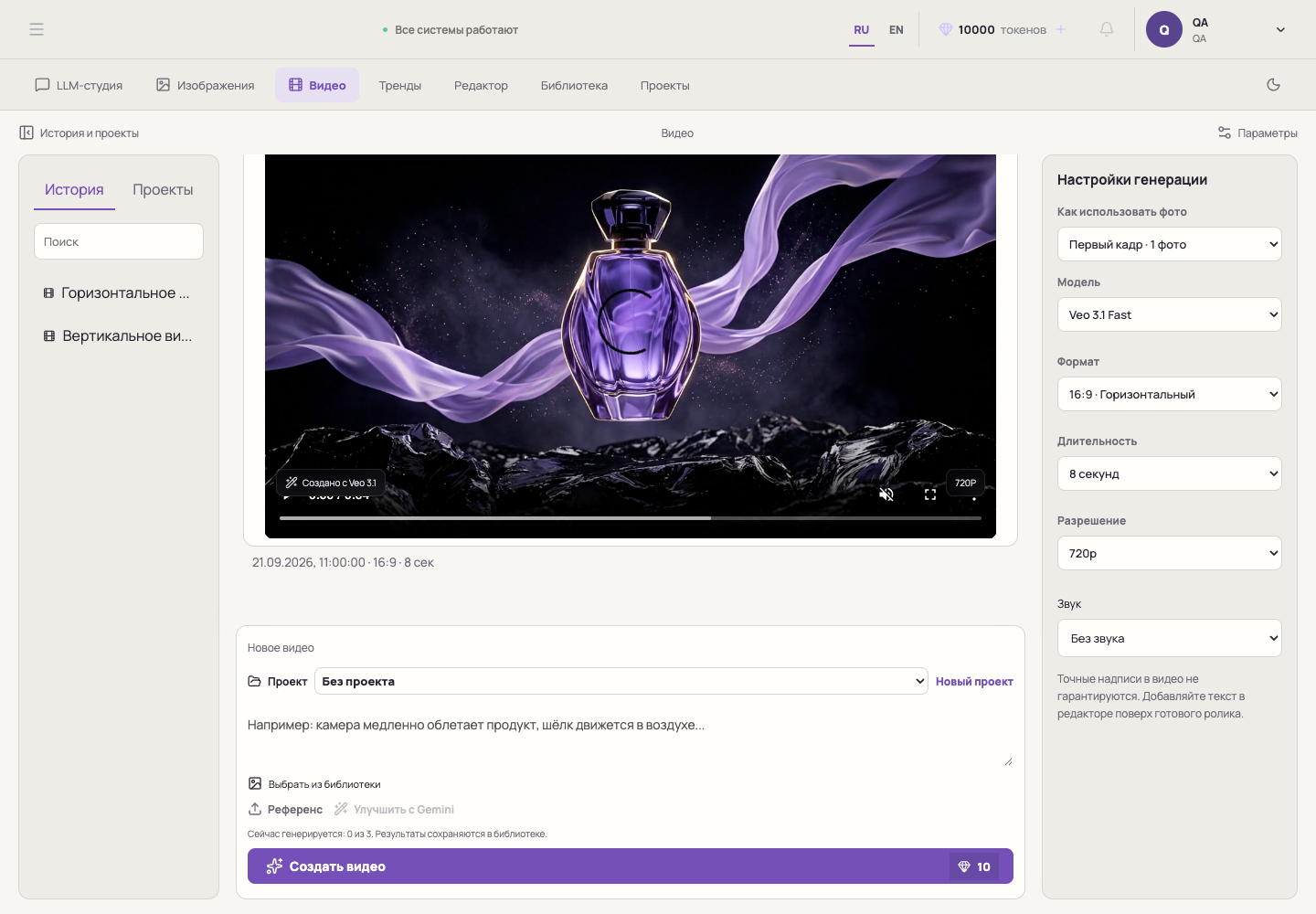
The new interface is organised around the work itself. History and projects sit on the left, the result and prompt are in the centre, and model settings are on the right. Both side panels collapse. The same structure becomes a single-column flow on mobile. A result stays visible while the next prompt is prepared, and generated files still go to the shared library.
The light theme is now the default, with a dark theme available from the same account. This was not a coat of white paint. Contrast, field borders, previews, sticky controls and the mobile generation button all had to survive both themes.
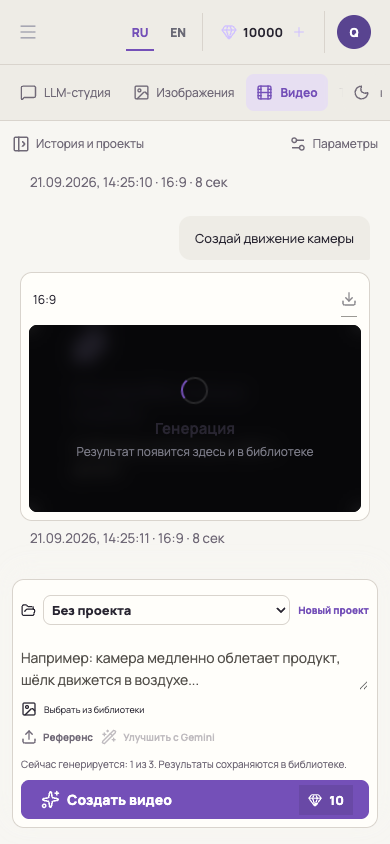
The small prompt box also needed work. Placeholder copy that looked like an ordinary sentence was not enough. It now has a visible label and instruction: enter text and describe what should be created. Model selection also explains what the chosen model is good at, how long it usually takes, and what it costs before the user starts a paid job.
An LLM studio inside the same product
Dantiva started with images and video. It now also has a text workspace powered by Gemini.
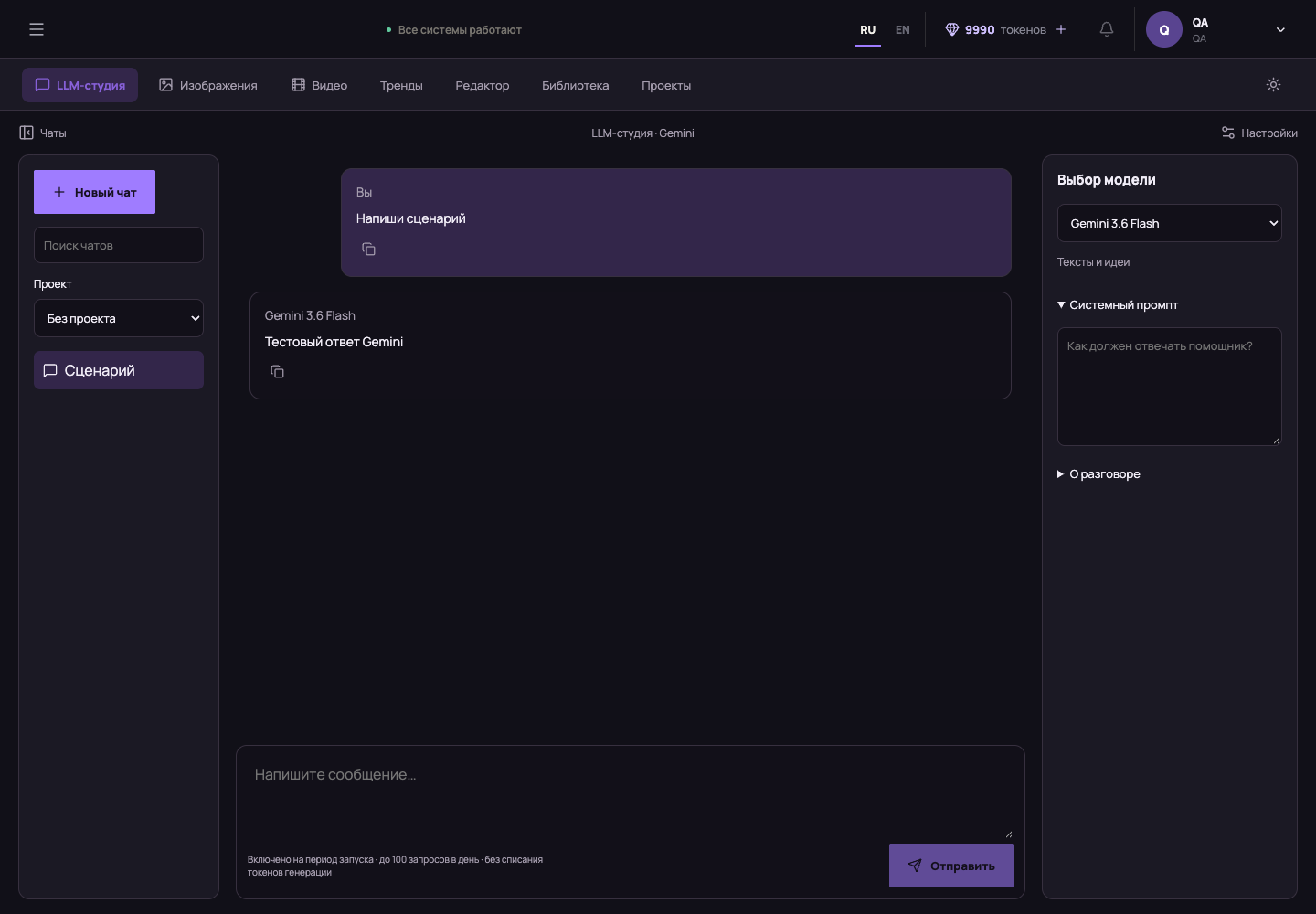
The LLM studio has separate chats, search, model selection, a system prompt, project context and server-side history. A conversation can be attached to the same project as its images and videos. At launch it is deliberately narrow: text only, no pretend file analysis, voice mode or local model that is not actually connected.
There are three available Gemini routes. Requests have per-user and global daily limits, and they do not spend the image and video balance during the launch period. A text reply and an eight-second video do not cost the provider anything like the same, so folding them into one counter would only make the pricing harder to explain later.
A second provider, without a second wallet
The larger technical change was adding OpenRouter for image generation and editing. Dantiva now offers two GPT Image 2.5 options:
- Flare is the faster default for modern image generation, prompt following and edits where faces or objects should remain recognisable.
- Sunburst is the more precise option for difficult details and careful editing, and usually takes longer.
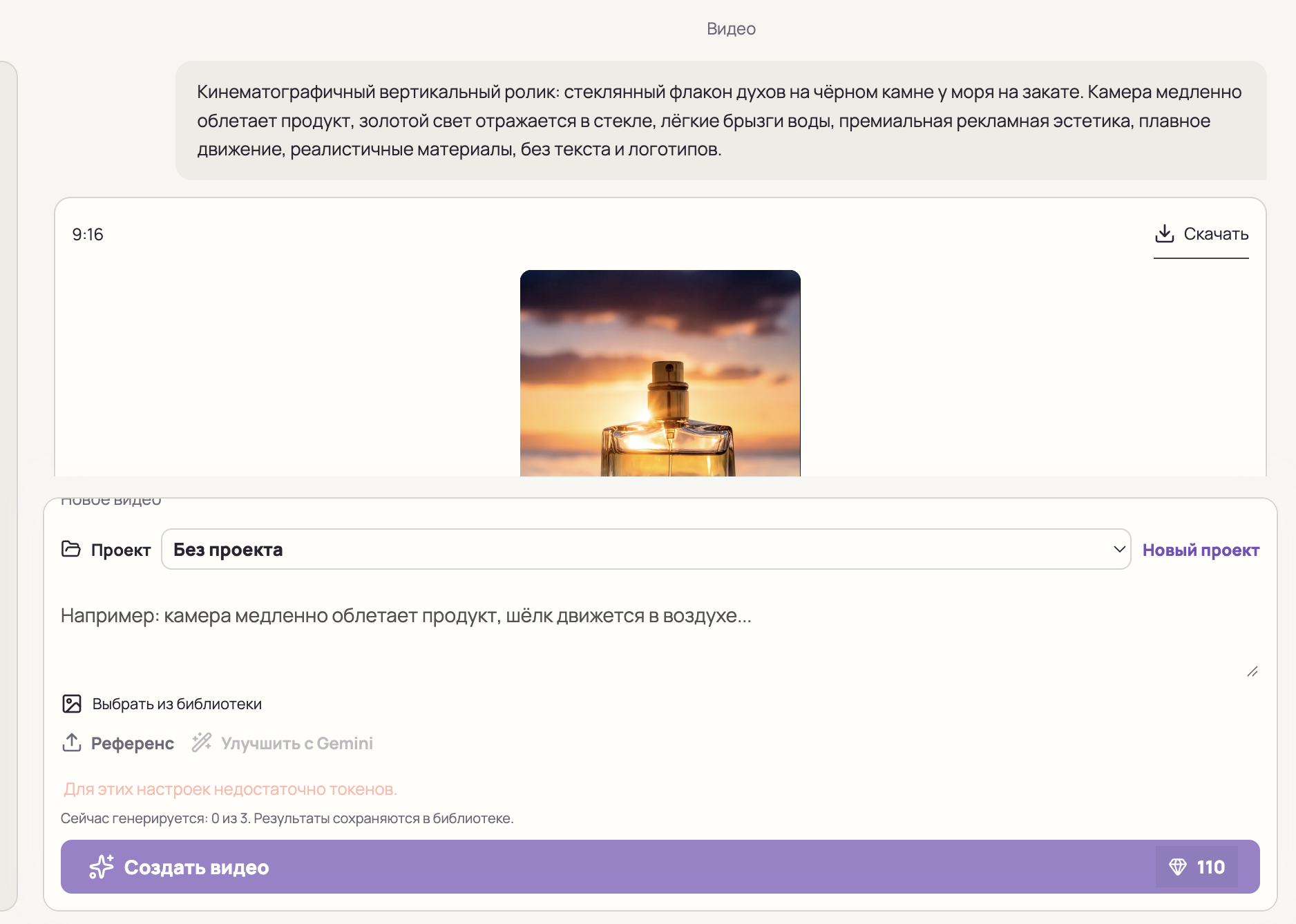
Both cost 300 Dantiva tokens per image at the current medium quality, with one result and up to four references including the source image.
The difficult part was not the API request. It was deciding which money is allowed to pay for it.
Google-backed generations can use the existing product rules, including some grants and issued access. OpenRouter is a direct external cost. GPT Image therefore uses purchased tokens only: an active subscription, a top-up or a one-time paid pack. Welcome tokens, partner bonuses, the old balance, administrative access and issued unlimited access cannot fund it.
There is still one account and one wallet. The server selects eligible paid buckets, reserves 300 tokens atomically, and records the original buckets. A duplicate callback cannot charge twice. If the provider fails, the exact buckets are restored once. An uncertain timeout is not retried automatically, because a hidden second paid request is worse than an explicit failure.
None of this shows up in a model demo, and most of it exists only because the money is real.
The first payment changed the questions
Before the first purchase, the main question was whether the whole path worked: sign in, choose a product, pay in rubles, receive a fiscal receipt, credit the correct wallet and use the balance on the website or in Telegram.
Now the questions are different. What was the customer trying to make? Why did the Mini App feel trustworthy enough to pay in? Do they return? Which model produces something they keep rather than merely test?
I am not publishing customer identity or presenting two payments as product-market fit. The useful fact is narrower: the commercial path has been used by a real customer, including the monthly subscription path in the Mini App.
Building from Croatia, for more than one market
Dantiva began with a practical Russian-speaking use case: access from Telegram, ruble payments and a receipt, without asking the user to solve foreign-card infrastructure first. The underlying product is broader. Its interface already has Russian and English modes, its infrastructure runs on Google Cloud, and its provider layer is no longer tied to one model family.
I have also sent two applications to Croatian innovation initiatives. One went to the BIRD incubator, for Dantiva together with its international build, AONETHA at aonetha.com: the same product aimed at Western markets, where payments are not connected yet. The second is for our other project, evidentio.eu. An application is not an award and I will not write it as one. It is a useful next step: the product now has to be understandable outside the context in which I built it.
That means explaining the actual innovation clearly. It is not that I trained a foundation model. I did not. The value is in the product layer around the models: one workflow across web and Telegram, a shared account and ledger, projects and reusable references, local payments, provider-specific economics, and release discipline when paid jobs can fail.
What the current version proves
Today Dantiva can:
- run text, image and video workflows in one project space;
- use Google Veo and Gemini alongside GPT Image through OpenRouter;
- keep one account, library and balance across the website, bot and Mini App;
- charge in rubles through YooKassa and deliver a fiscal receipt;
- reserve, capture and refund tokens without charging a duplicate request twice;
- keep free access useful while preventing it from silently spending money on a provider that is not grant-funded.
It does not prove repeat retention, a stable acquisition channel or product-market fit. Those are the next tests.
Building the first version told me the system could be assembled. The first customer told me that someone can walk the whole path without me standing behind them: sign in, pay, get the receipt, spend the balance. What I want next is a second purchase that surprises me less than the first one did.
If you are building an AI product with several providers, paid jobs and more than one interface, I would be glad to compare implementation notes. The model call is still the easy part.
FAQ: Dantiva after the first paying customer
When did Dantiva get its first paying customer?
The first confirmed one-time purchase was made on 17 September 2026. The first monthly Start subscription was bought through the Telegram Mini App on 21 September 2026.
Which models does Dantiva run on?
Google Veo and Gemini through Vertex AI for video, images, prompt improvement and the LLM studio, plus GPT Image 2.5 Flare and Sunburst through OpenRouter for image generation and editing.
What does a GPT Image 2.5 generation cost in Dantiva?
300 tokens per image for both Flare and Sunburst, at the current medium quality, with one result and up to four references including the source image.
Why can free tokens not pay for GPT Image?
OpenRouter is a direct external cost rather than a grant-funded one. GPT Image therefore runs on purchased tokens only: an active subscription, a top-up or a one-time paid pack. Welcome tokens, partner bonuses, the old balance, administrative access and issued unlimited access cannot fund it.
Do two payments mean product-market fit?
No. They confirm that the commercial path works end to end, including the monthly subscription in the Mini App. Repeat retention and a stable acquisition channel have not been tested yet.
Keep reading
All articlesThe model is the easy part. What building Dantiva taught me
Build notes on Dantiva, an AI photo-to-video studio on Google's models: three front doors, a reserve and refund ledger, a rename I refused to finish, three pricing rounds, and the wall the product hit.
ReadI'm not an engineer. I fine-tuned my own language model on a MacBook Air
How I fine-tuned Qwen3 8B with LoRA on a MacBook Air with 16 GB, four attempts, 576 examples, where the metrics lied, and what the model actually learned.
ReadA RAG chatbot on your company knowledge base: what it is and when it pays off
RAG in plain language: which businesses benefit from a bot that answers from their documents, what to prepare, where projects fail, why a pilot takes two weeks.
Read